


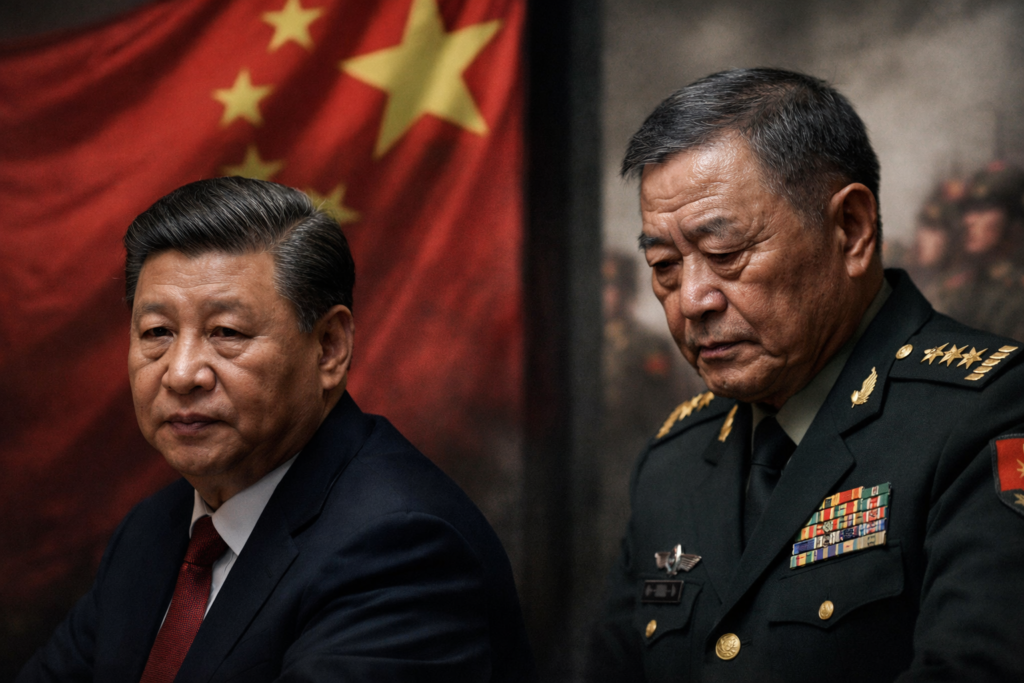
China has removed one of its most senior military leaders in a purge that has left the country’s armed forces facing an unprecedented leadership vacuum, and intensified scrutiny of President Xi Jinping’s control over the military.
Zhang Youxia, 75, vice-chairman of the Central Military Commission (CMC), has been placed under investigation alongside General Liu Zhenli. The move is part of an expanding anti-corruption drive that has steadily thinned the upper ranks of the People’s Liberation Army (PLA).
According to reporting by the BBC, the purge has reduced the CMC, the Communist Party body that commands China’s armed forces, to just two members: Xi Jinping and General Zhang Shengmin. The commission typically includes around seven officials.
The concentration of power is without precedent. The CMC oversees millions of troops and has historically been one of the most influential institutions in China. Even Deng Xiaoping ruled largely through his control of the commission.
“The PLA is in disarray,” Lyle Morris of the Asia Society Policy Institute told the BBC, describing the situation as a “major leadership void” that reflects poorly on Xi’s grip over the military.
Official statements have offered little explanation beyond accusations of “serious violations of discipline and law”, a phrase commonly used to signal corruption. An editorial in the PLA Daily reinforced the message, declaring the party’s “zero tolerance” approach and insisting no official is above punishment.
Yet analysts say corruption alone may not explain the scale of the purge.
As reported by the BBC, speculation around Zhang’s downfall has ranged from factional infighting to allegations of espionage or coup plotting, claims that remain unverified and impossible to independently confirm in China’s tightly controlled information environment.
“What this shows,” said Associate Professor Chong Ja Ian of the National University of Singapore, speaking to the BBC, “is both Xi’s unchallenged authority and the severe limits on information in Beijing, which fuels uncertainty and rumours.”
Once senior officers are publicly named as under investigation, imprisonment is widely assumed to follow. The PLA Daily has already described Zhang and Liu as having betrayed the Communist Party’s leadership.
Xi’s anti-corruption campaign initially targeted genuine graft, but critics argue it has also been used to remove rivals and enforce loyalty. The result is a level of control not seen since Mao, but one that may come with risks.
Within the military, repeated purges can foster fear and caution. Zhang’s removal is especially striking given his long-standing ties to Xi: their fathers were revolutionary comrades, and Zhang was widely viewed as a trusted ally. He was also among the few senior PLA figures with combat experience.
“This sends a signal that no one is safe,” Morris told the BBC, warning of prolonged instability within the armed forces.
The purge comes as Beijing continues to escalate pressure on Taiwan. Analysts caution, however, that China’s strategic ambitions are unlikely to change.
“The purge does not affect China’s goal of controlling Taiwan,” Chong said. “But it may mean operational decisions are shaped even more by Xi himself, rather than by experienced military professionals.”
For officers still serving, the message is stark: promotion now brings heightened risk. As China’s military leadership narrows, authority may be more centralized than ever, but also more fragile.

