The 56,000 wealthiest adults on the planet – a group that could fit inside a single football stadium – own assets three times as large as those of the poorest half of humanity combined, writes Ricardo Gómez-Carrera, summarising the key findings of the World Inequality Report 2026. Such levels of wealth inequality, while extreme, are not inevitable. Which two policy levers have particular potential to redress these imbalances?
Consider half of the world’s adult population, about 2.8 billion people, and add up everything they own: their houses, their savings, their belongings, minus their debts. Then do the same for the 56,000 wealthiest adults on the planet, a group small enough to fit inside a single football stadium. The stadium’s wealth would be greater. In fact, the wealth of the people of the stadium would be three times as large as that of half of humanity combined.
That is one of the headline findings of the World Inequality Report 2026, which I co-authored with Lucas Chancel, Rowaida Moshrif, and Thomas Piketty, and which draws on research and data compiled by more than 200 researchers affiliated with the World Inequality Database and the World Inequality Lab. The report’s central message is simple and astonishing: the world is extremely unequal, and at the very top, extreme wealth inequality is (still) rapidly increasing.
Income inequality is large, but wealth inequality is extreme
The global top 10%, about 560 million adults, earn around 53% of all global income in a given year. The bottom half of humanity, 2.8 billion people, collectively receives 8%. So, 10% of the world earns more than 6 times what half of the world earns. That alone is a striking gap.
But when you look at wealth, the picture is far more extreme. The top 10% owns three-quarters of whatever there is to own while the bottom half holds only 2%. Meanwhile, the top 1% alone controls 37% of all wealth, roughly eighteen times more than the entire bottom 50%.
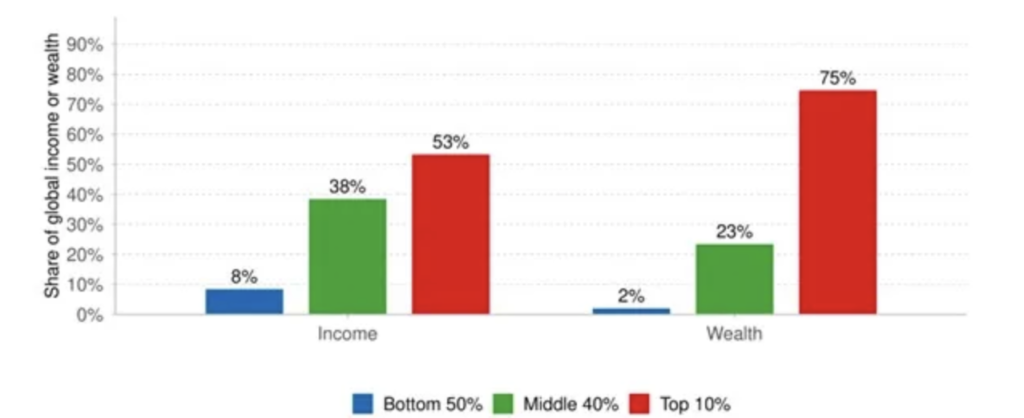
Share of global income and wealth by group, 2025
Now consider the top 0.001% of the adult population (about 56,000 individuals). In 1995, this tiny group owned around 4% of global personal wealth. By 2025, their share had risen to about 6%. Over the same three decades, the share held by the bottom half of humanity barely moved, hovering around 2%. Extreme wealth inequality is not only persistent, it is also increasing.
Wealth is growing much more for the already extremely wealthy
This increase in global wealth inequality at the top is most clearly visible in a wealth growth incidence curve. This figure plots how fast different slices of the global distribution have been getting wealthier over time.
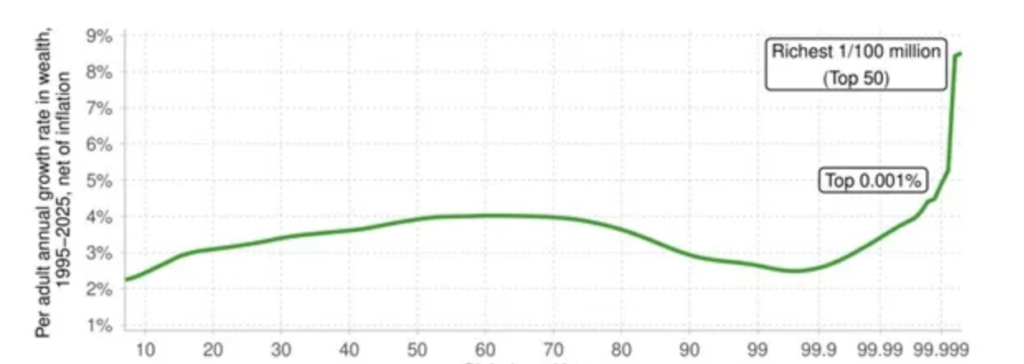
The wealth growth incidence curve, 1995-20
For the bottom half of the world, wealth grew at about 3.4% per year after inflation. For the top 10%, it grew at 2.9%. At a glance, you might think inequality could be narrowing since the wealth of poorer households is growing faster than that of the richest 10% of households.
But that comparison is deceptive because it averages together very different groups. If you disaggregate the top 10%, and even the top 1%, – a unique feature of the World Inequality Database – the picture flips completely. The top 0.001% saw their wealth grow at close to 5% per year between 1995 and 2025, and the world’s few thousand billionaires increased their wealth at more than 8% per year. Both groups increased their wealth significantly more than the bottom 50%.
It is important to notice that growth rates hide what matters most: the starting point (or baseline). A person in the bottom 50% owns, on average, about $6,500. A 3.4% annual increase gives them roughly $220 of extra wealth over a year. A member of the top 0.001% (the privileged football stadium group) – whose average net worth is around $1 billion – gains over $48 million in the same year, if current trends continue. The 50 wealthiest individuals on the planet, with an average wealth of around $53 billion each, each gain more than $4.5 billion a year.
Put differently, while an average person in the bottom half would gain enough in a year to buy a second-hand fridge, someone at the very top would add the entire GDP of a low-income country to their wealth.
Inequality is not an anomaly, but a feature of the system
A natural reaction to numbers like these might be to assume they are driven by an outlier or a few unusual cases. They are not. As the report documents in detail, wealth inequality is extreme in every region of the world.
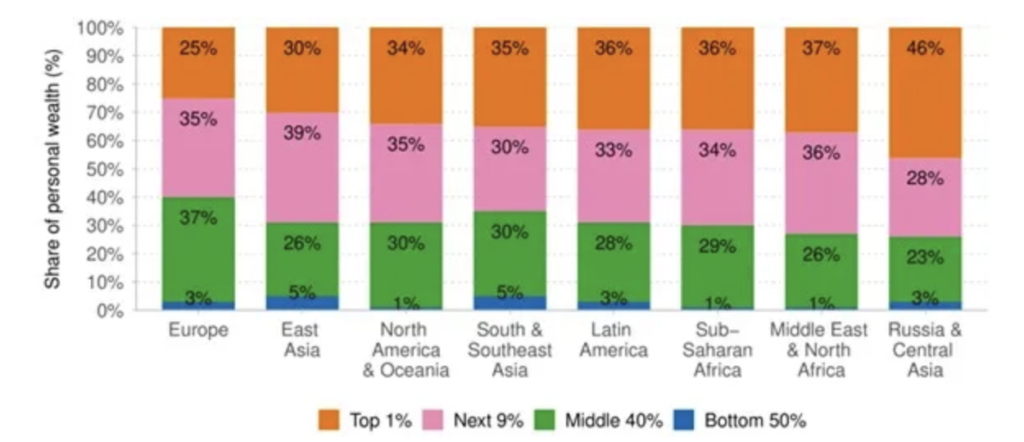
Bottom 50%, middle 40% and top 10% (top 1% and next 9%) wealth shares across the world (2025)
Even in Europe, the region with the lowest wealth inequality in the world, the top 1% owns 25% of all wealth, more than eight times what the bottom half of the population owns combined. Everywhere else, the concentration is more severe still.
And in most regions of the world, the top 1% of the population owns roughly the same share or more than the bottom 90% combined. Extreme wealth concentration is not an anomaly but a systemic trait of our economic system.
Inequality is a political choice
These numbers describe a system that did not arise by accident and will not correct itself. As the report argues, inequality is not inevitable; it is a political choice. It is the outcome of decisions about taxation, ownership, and institutional design, and different decisions would produce different outcomes.
How can inequality be reduced? The report points to two policy levers with particularly strong evidence behind them. The first is progressive taxation all the way to the top of the distribution. When a small group accumulates wealth much faster than everyone else, that wealth tends to compound – through investment returns, inheritance, and political influence – and the gap widens with each passing year. Progressive taxes slow that compounding. They also provide resources that can fund public goods, which benefit everyone. Far from holding growth back, a fairer distribution tends to strengthen it, since economies where most people have purchasing power and opportunity are more dynamic than economies where demand depends on a shrinking minority.
The second is public investment in education. Education is the closest thing we have to a universal equaliser. When every child has access to good schools and the chance to develop their abilities, then their life chances are determined by talent and effort, rather than the wealth of their parents. Investing in education is also one of the highest-return investments a society can make. Societies that waste the potential of most of their children grow more slowly than they otherwise could. Investing in human capabilities is one of the few policies that reduces inequality and expands the economy at the same time.
Implementing these policies is not a technical puzzle. Both are political choices. Extreme inequality is not there because of market forces alone. It is there because of rules, and rules can be rewritten.
The World Inequality Report 2026, co-authored by Ricardo Gómez-Carrera, Lucas Chancel, Rowaida Moshrif, and Thomas Piketty, is available at wir2026.wid.world.
This article was produced by The London School of Economics and Political Science
Author
-
Ricardo Gómez-Carrera is the Lead Author of the World Inequality Report 2026, a researcher at the World Inequality Lab, and a PhD candidate at the Paris School of Economics. His research focuses on inequality, development, education, and labour economics. He previously worked at Mexico’s Central Bank and the Ministry of Finance. In 2024, he received the prestigious Joaquín Xirau Icaza Economics Research Award for his research on human capital development.