


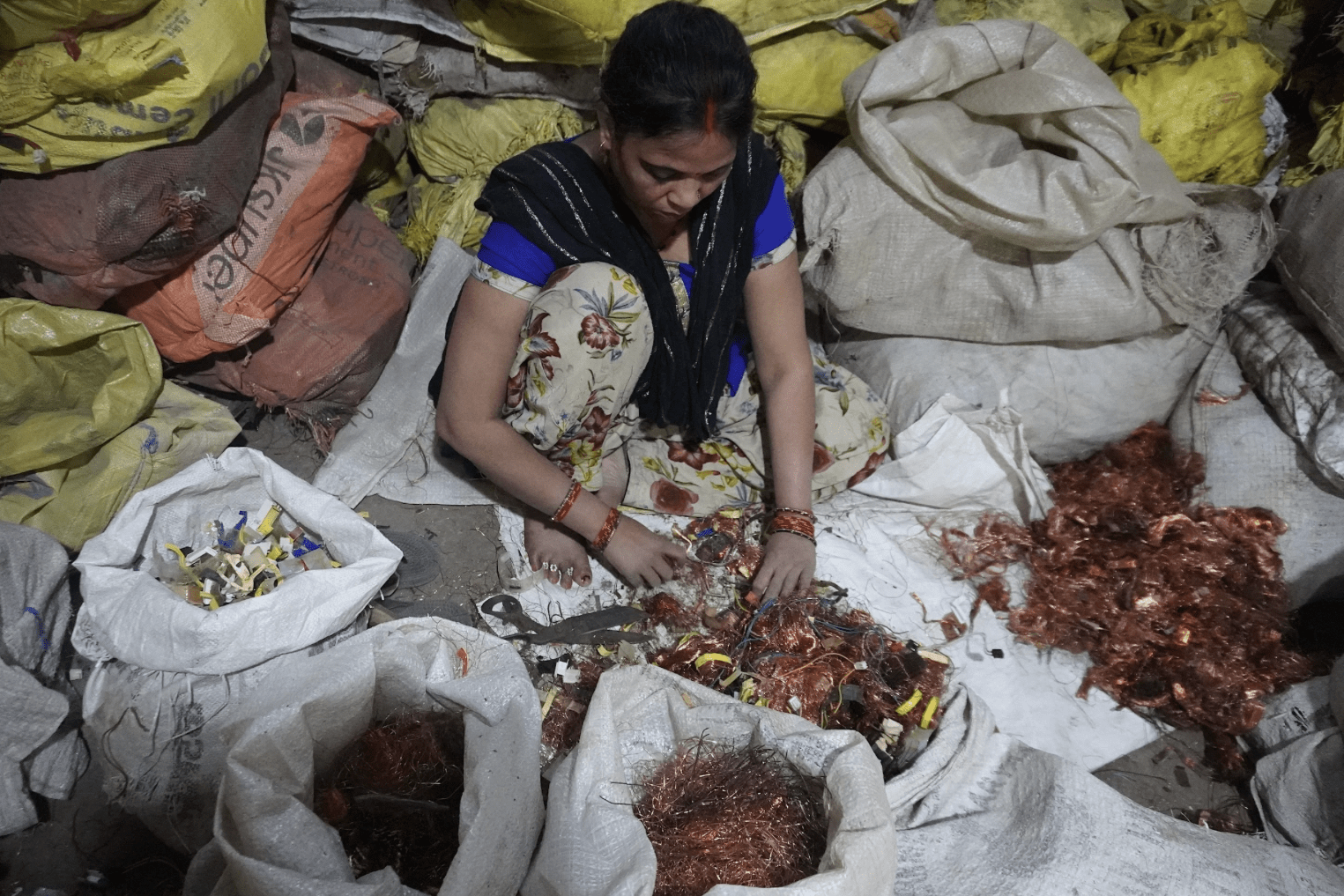
“Why do you want to know what we do? Do you want to steal our work and shut our shops?”
Seelampur, a neighbourhood in north-east Delhi, had seemed extremely loud until then; an endless cacophony of honking rickshaws, shouting vendors and the loud sizzle of oil from food stalls that eat up most available walking room.
Until he spoke. Hostile, worried and anxious all at once.
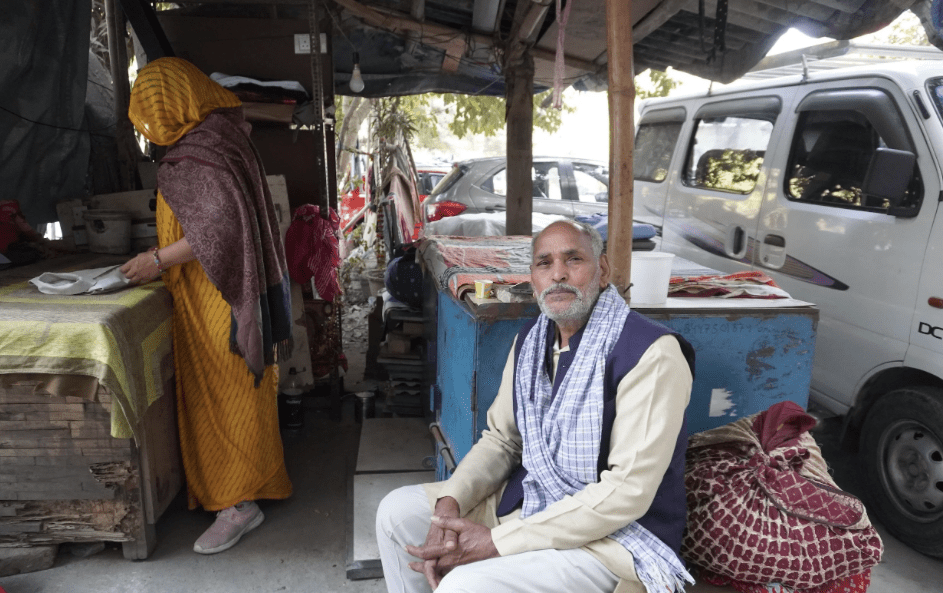
Behind the middle-aged man was his e-waste refurbishing shop. Huge white sacks, some bulging, some half-tied, spilled into every available corner. Among them, almost blending into the landscape, were men, women and children hunched over. Their hands moved quickly with practiced precision across fragments of metals.
What once belonged to another life arrives here as waste, only to be broken down again into something that can be sold. Seelampur is one of the Indian capital’s largest hubs for informal e-waste recycling.
Here, a laptop becomes copper wiring, aluminium and circuit boards; a mobile phone yields tiny quantities of gold, silver and other recoverable metals; and an old transistor radio could turn into scraps of reusable components.
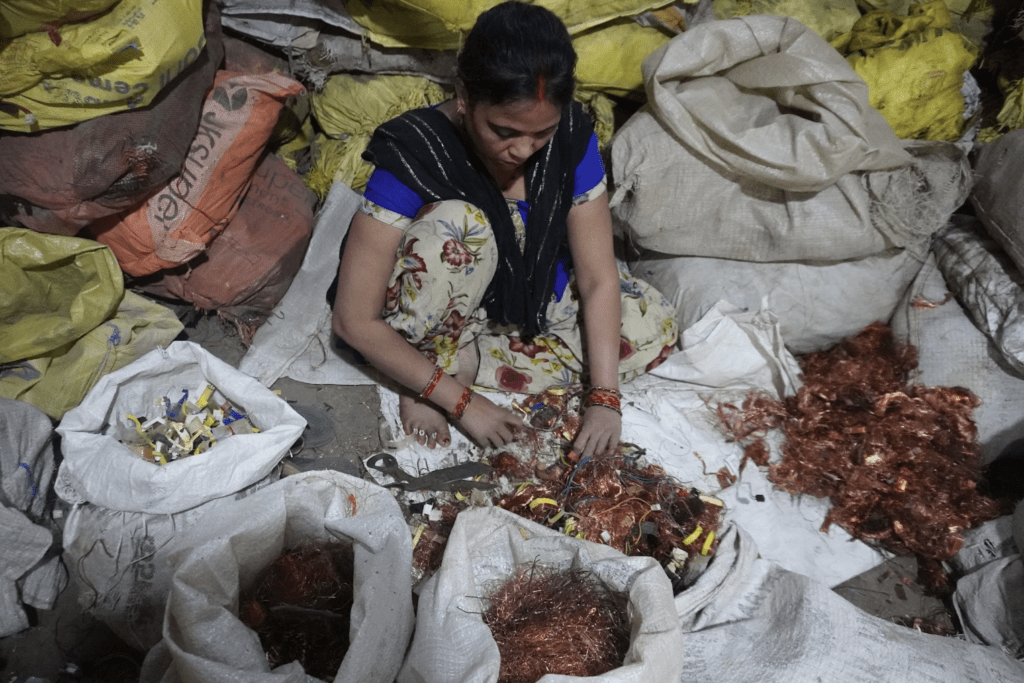
Pinky Saxena separates copper and other valuable metals from discarded electronics at a workshop in Seelampur, Delhi. She is paid INR 4 (USD 0.042) per kilogram, her daily income determined by how much material she can recover (Image: Safina Nabi)
But what can often seem like scattered, small-scale work is in fact part of a vast, unregulated economy that sustains thousands of lives. Research indicates over 50,000 informal workers in Seelampur are involved in the “collection, dismantling, segregation, and rummaging for metals extraction through acid washing, and open burning”.
This labour comes at a cost: without formal safeguards, workers – few of whom use protective equipment – are routinely exposed to toxic chemicals such as lead, mercury and acid residues. The processes used to extract the metals also pose an environmental hazard through emissions and leeching of pollutants.
And it comes in a country that has steadily raised its climate ambitions. Under India’s updated national climate action plan, the country aims to cut the emissions intensity of its GDP by 47% by 2035, compared with 2005 levels. The transition is being driven by measures such as expanding renewable energy, investing in battery storage, and pushing for cleaner manufacturing and infrastructure.
Analysis by the Centre for Research on Energy and Clean Air shows India’s carbon dioxide emissions are already slowing, with CO2 emissions growing by just 0.7% in 2025, the slowest increase in over two decades. This marked a sharp drop from the 4-11% growth seen in the preceding four years.
As the world’s third‑largest emitter of greenhouse gases after China and the US, India faces a massive workforce challenge. A substantial portion of the country’s economy runs on its informal sector, which contributed about 45% to the GDP in 2022-23. Many of these workers earn their living in sectors that rely on fossil fuels or emit greenhouse gases; jobs that are deeply embedded in the local cultural landscape. In cities, for instance, there is the ubiquitous local dhaba, or roadside food stall, that runs on coal-fired ovens; or the presswala, a typically family-run clothes-ironing business operated out of a shack.
To understand how the green energy transition is impacting their lives, Dialogue Earth spoke with five informal workers in urban and rural areas across two different Indian states, each from a different trade. They unanimously expressed a deep sense of worry that the transition was leaving them behind.
As the man in Seelampur put it: “Our livelihoods are under threat.”
The weight she carries
Sushila Devi reaches her roadside ironing shack just as the first light begins to settle over Khirki, a village in south Delhi. The 50-year-old pours a little water onto the dusty ground and begins sweeping; a method of claiming her small, cleaned space before the day begins in earnest.
She opens a metal almirah (free-standing cabinet) and pulls out two heavy irons and a bucket of charcoal. Devi fills them with the coal and waits; the equipment must be ready before her father-in-law and son arrive for work.
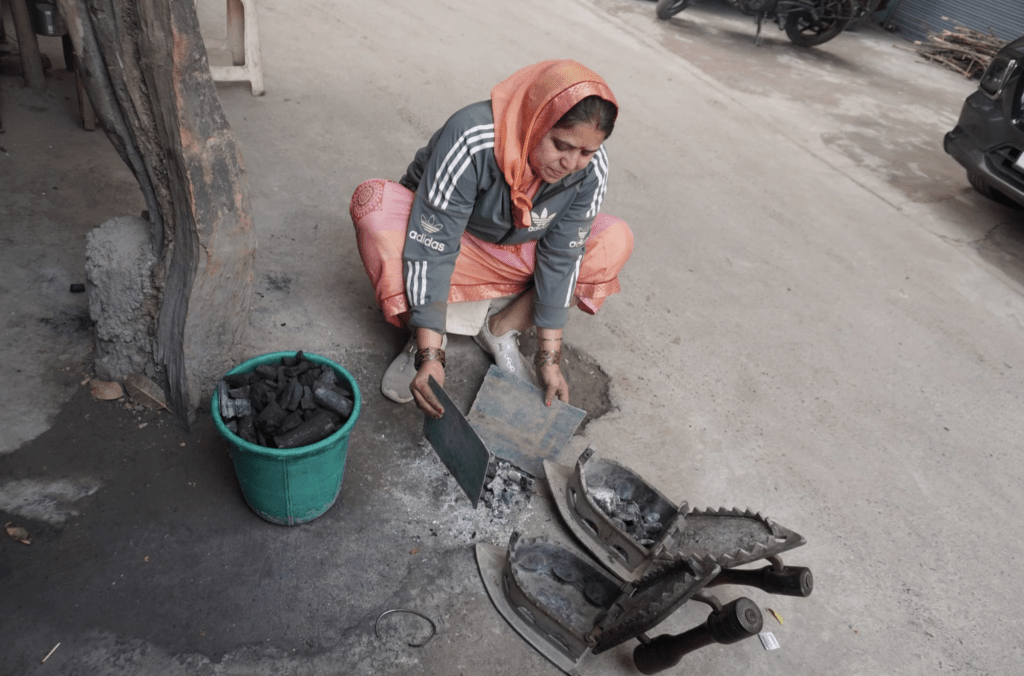
Sushila Devi at her roadside ironing shack in south Delhi, filling heavy irons with leftover coal before adding a fresh supply on top. The coal is then lit and burns until the irons are hot enough to press customers’ clothes (Image: Safina Nabi)
Up close, her hands tell their own story. They have been worn down by years of labour, callused by the coal, darkened by the heat. “The iron is very heavy and using it constantly has left me with severe pain in the shoulder,” Devi says.
There is little comfort around. No fan to cut through the heat, no tap for cool water, no corner to rest in. By noon, the irons are almost too hot to touch. “In summer, the heat rises from the street and the irons,” Devi explains. “At times, I get so dehydrated that I get a severe headache and lose my appetite for days.”
But winter proves even more uncertain for her livelihood. “That is when we struggle the most,” she says.
“Pollution increases, government announces restrictions, and anything that causes pollution must stop.”
These restrictions are often enforced under Delhi’s Graded Response Action Plan, a four-stage system that imposes progressively stricter restrictions as air quality worsens. At Stage I, when air quality enters the “poor” category, authorities can restrict the use of coal and firewood. Higher stages bring tighter curbs on construction, industrial activity, as well as the use of diesel generators and vehicles.
Among the first casualties are coal and firewood-based activities that sustain thousands of informal workers, from roadside ironing stalls to small workshops and furnaces. As restrictions tighten, fuels that are essential to these livelihoods become harder to access or more expensive, leaving workers to absorb the costs without necessarily having the means to switch to alternatives.
Sushila Devi irons clothes while keeping her face covered with her saree. She is observing the tradition of not appearing face-to-face before her father-in-law, even while working long hours in Delhi’s extreme heat (Image: Safina Nabi)
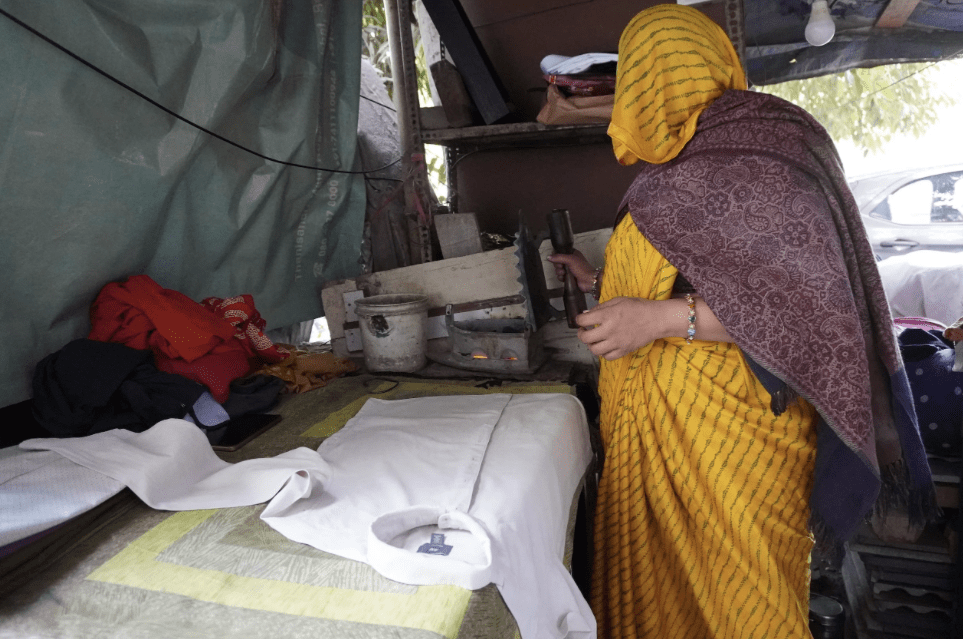
As restrictions tighten, the supply of coal becomes unpredictable. “Sometimes it just disappears,” she says. “The suppliers start playing hide and seek. When it does come, they spray it with water to make it heavier, so we end up paying more for less.”
On most days, she makes around INR 400-500 (USD 4.20-5.30). “But when coal is expensive or not available, even that becomes difficult.”
For workers like Devi, there are many barriers to the adoption of clean energy. They don’t get coal through formal channels, “where they can show a ration card and receive it at a regulated price”, explains Rahul Tongia, senior fellow at the Centre for Social and Economic Progress. “Instead, they rely on informal networks, what we might call jugaad – leftover or diverted coal from the secondary market.”
That tension, between survival and regulation, shapes Devi’s life – and those of many others.
A family of eight
Mohammad Qasim lives in Shaheen Bagh, a neighbourhood in south-east Delhi, and has worked at a small roadside eatery for the past two years. Cooking in a tandoor, or clay oven, is entirely dependent on coal, the 19-year-old says. “The grilling process cannot be done without charcoal.”
In his mind, his work is tied not just to skill, but to a system that offers no easy exits. Winters, like for Devi, are difficult. “We cannot do anything else. We face problems when the government shuts down tandoors,” he notes. “Their point may be fair, but what will we do? How will we live? If we don’t work, we don’t eat.”
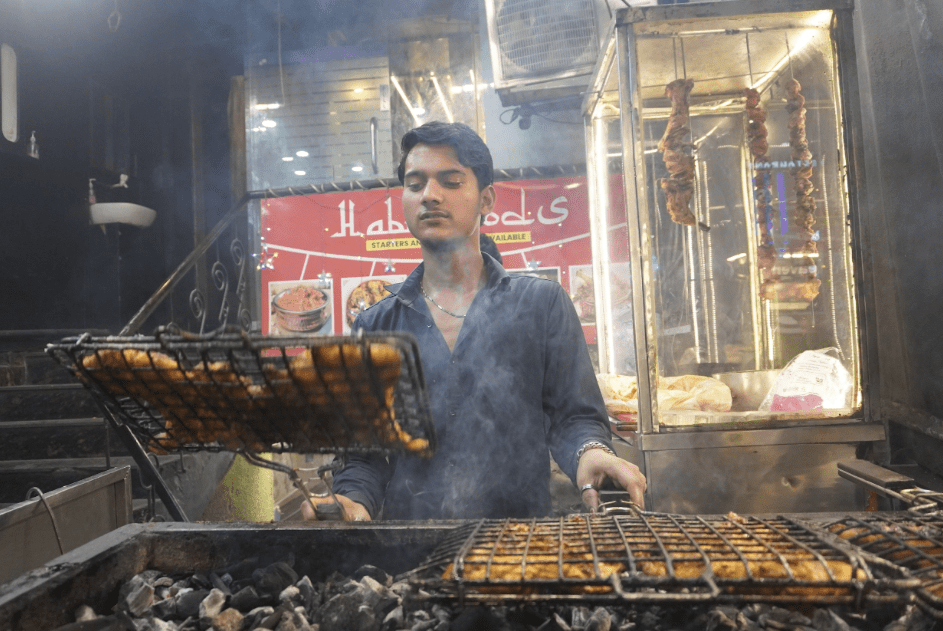
Mohammad Qasim grills chicken over a coal-fired tandoor outside a roadside eatery in Delhi. Coal remains central to many small food businesses despite increasing pollution-related restrictions (Image: Safina Nabi)
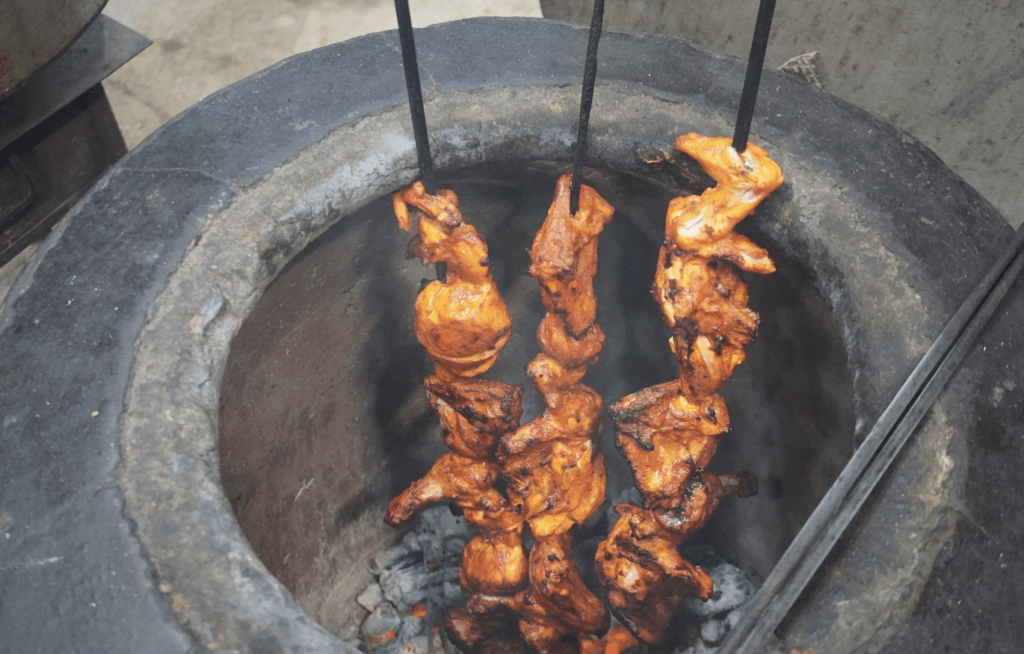
A charcoal-fired clay tandoor outside an eatery in Shaheen Bagh, south-east Delhi, with iron skewers used for grilling chicken suspended above the glowing coals (Image: Safina Nabi)
A few kilometres away, on the outskirts of Delhi’s Malviya Nagar neighbourhood, blacksmith Vikram Mani has set up shop under a tree; a shop that morphs into a home for his family of eight at night. He has been part of the informal labour force since he was 15, building construction equipment and household utensils ranging from axes and hatchets to woks and iron skillets.
That life of labour has brought very little fortune. His home still lacks a toilet. “In the morning, there is no proper way to wake up, freshen [up] or cook,” he said. “First, we rush to find a toilet, then water.”
His work, too, is built around coal. Mani heats raw iron in a small furnace until it softens, and shapes it into tools which he sells. On average, he earns INR 30-40 (USD 0.30–0.40) per item. “We barely survive.”
With margins so tenuous, any disruption to the coal supply has serious consequences. “When incomes are this low, even modest increases in input costs or disruptions to supply can have outsized consequences,” Tongia explains. “That’s why social protection and support mechanisms need to be built into transition planning from the outset.”
Changed habits, losing livelihoods
Thousands of kilometres away, the forests of Kashmir are markedly different to the bustling streets of Delhi. Here, the air is quieter, broken by the sound of cowbells and the crackle of wood fires. Scattered along the forest edge are settlements of the Gujjar and Bakarwal communities – characterised by clusters of mud and wood houses known as dhokh.
Gujjar families burn dead wood and felled timber, converting it all into charcoal that is used to fuel kangri – small wicker fire pots that they tuck under their woollen robes to stay warm through the harsh winters.
Life in the community revolves around the forest. Throughout the year, families rely on it for fuel, fodder and grazing land. The work is seasonal but predictable, helping sustain households through Kashmir’s long winters.
“But with time, and because of climate change and shifts in people’s behaviour, we are losing everything,” says Iqbal Deedar, who, like his father before him, makes kangri fuel. “Not only work, but survival itself.”
Deedar explains that from May until October, he used to make charcoal and sell it in city centres. But now, demand has more than halved: “People prefer other electric and gas options to keep warm.”
Gunjan Jhunjhunwala, programme lead for renewables at the Council on Energy, Environment and Water, a think-tank, says that few sectors can match the stability still provided by the coal industry to its workers. Such workers are also hesitant to relocate for work. “We need to think of active and comprehensive regional development plans that attract… sectors which are [similarly] able to employ and match the wages and social security of workers,” she says.
Jhunjhunwala suggests formally certifying workers’ existing skills, with provision for “top-up skills training” so they can progress into higher-paying job roles.
A blog from World Resources Institute India highlights administrative solutions for informal workers that could help soften the blow of the green energy transition. “Expanding social security coverage, including pension schemes and healthcare access, is crucial to safeguarding these workers,” the authors write. “Wage security programs and financial assistance can provide immediate relief, while targeted re-skilling initiatives can help them transition into emerging green jobs.”
They point to Jharkhand’s plan for a livelihood transition initiative, which will connect informal workers in the state’s mining regions with alternative employment options. “Establishing similar worker registration systems nationwide will improve access to government benefits and create a more resilient workforce in a changing economy,” the authors note.
For informal workers from Delhi’s Seelampur to the forests of Kashmir, “transition” is not a policy slogan, but a daily calculation: the nebulous balance between staying alive today and losing livelihoods tomorrow. Government plans may be written to meet climate targets, but they must factor in the risk absorbed by the same hands that keep the country running.
Back in Seelampur, the sceptical man watches over sacks of discarded electronics waiting to be dismantled. “People talk about the future,” he says. “But nobody tells us where we fit into it. If these shops close, what will happen to all of us?”
This story was originally published by Dialogue Earth and is republished under a Creative Commons license. The views and content expressed in the article are solely those of the original publisher, and Newting bears no responsibility for them.

