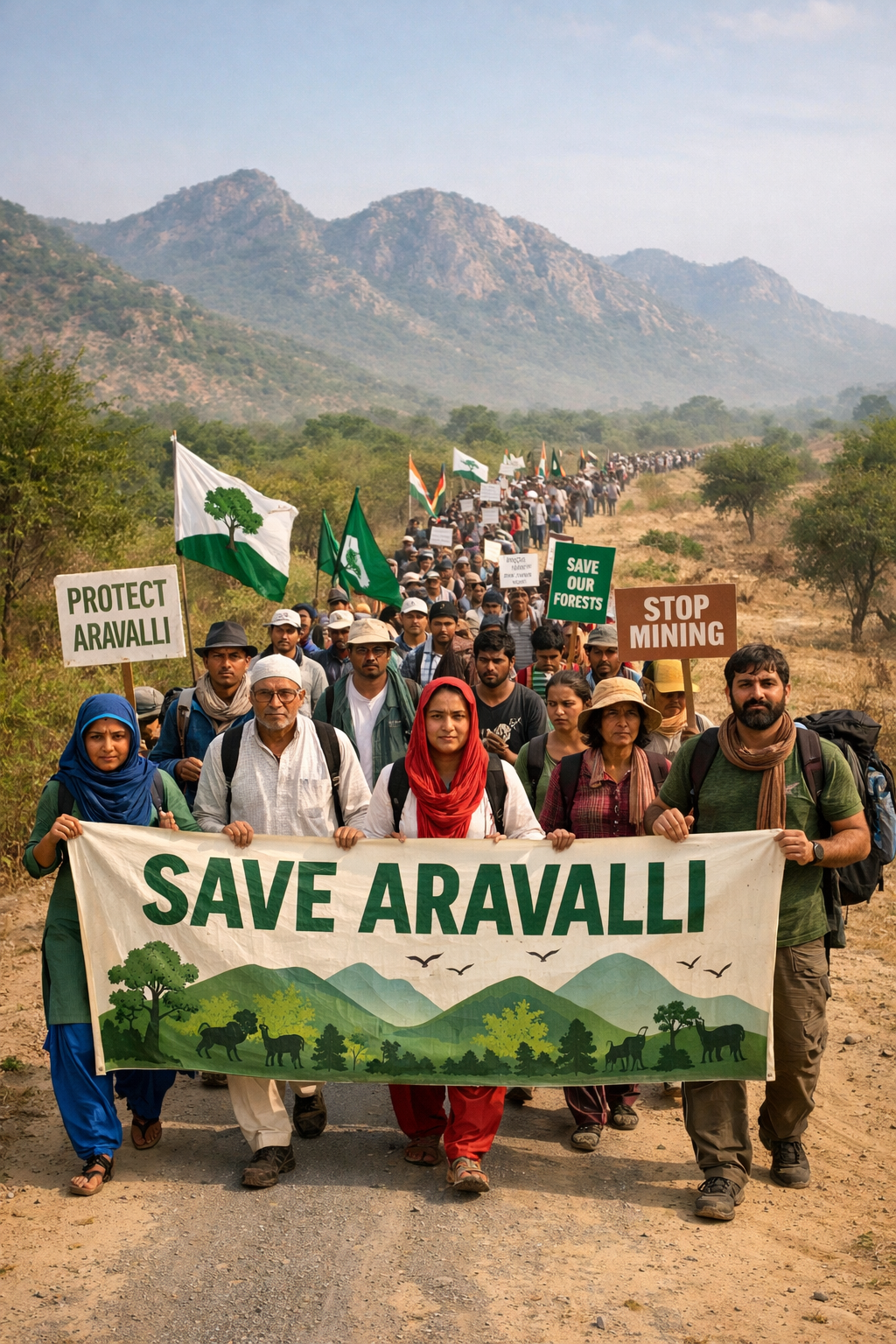
In a push to highlight and safeguard the Aravalli hills, the world’s oldest surviving mountain system, the Aravalli Virasat Jan Abhiyan announced in a press conference on Thursday a 700-kilometer foot march to the mountain range.
Called the “Aravalli Sanrakshan Yatra”, the rally will begin on January 24 from Gujarat’s Aravalli district and will pass through three districts in Gujarat, 27 districts in Rajasthan and seven districts in Haryana, before concluding in Delhi after more than 40 days.
Aravalli Virasat Jan Abhiyan is a coalition of environmentalists, ecologists, lawyers, researchers, social activists and rural and urban communities, largely from Gujarat, Rajasthan, Haryana and Delhi. The campaign aims to draw attention to what organisers describe as the rapid ecological degradation of the Aravalli range and growing legal uncertainty around its protection.
Supreme Court Ruling
The yatra comes against the backdrop of a November 20, 2025, Supreme Court judgment that endorsed a government committee’s revised definition of the Aravalli hills. Under this definition, an Aravalli hill is any landform rising at least 100 metres above surrounding terrain. Two or more such hills within 500 metres of each other, along with the land between them, would qualify as part of the Aravalli range.
Environmentalists warned that such a height-based definition could leave numerous lower, scrub-covered but ecologically vital hills outside legal protection, making them vulnerable to mining and construction.
Following the ruling, peaceful protests were held in cities such as Gurugram and Udaipur, involving residents, farmers, environmental groups, and in some cases lawyers and political parties.
However, in December, the Supreme Court stayed its own November order. A vacation bench of Justice Surya Kant and Justices J.K. Maheshwari and A.G. Masih ordered the formation of a new expert committee to examine issues that require examination in terms of the definition of the Aravallis.
In its ruling , the Supreme Court said that clarifications are necessary on the definitions approved earlier. The Court also issued notice to the Centre and the four Aravalli States, Rajasthan, Gujarat, Delhi and Haryana, seeking their response to its suo motu case on the issue.
Moreover, to preserve the integrity of the range, the Union Ministry of Environment, Forest and Climate Change also issued directions to the states for a complete ban on the grant of any new mining leases in the Aravallis.
Why the Aravallis Matter
Stretching nearly 670 kilometres across northwestern India, the Aravalli range begins near Delhi, runs through Haryana and Rajasthan, and ends in Gujarat. The highest peak in the range rises to about 1,722 metres.
For centuries, the Aravallis have served as a natural barrier between the Thar Desert and the Indo-Gangetic plains, slowing dust-laden winds that would otherwise sweep eastward.
The range also plays a crucial role in groundwater recharge, with rainwater seeping through fractured rock systems to replenish aquifers that support farming, cities and industry. Major rivers such as the Chambal, Sabarmati and Luni originate from or are sustained by the Aravalli system.
Ecologically, the hills support diverse flora and fauna in an otherwise semi-arid region. Forest patches, scrublands and rocky outcrops together form wildlife corridors connecting protected areas across states, an ecological continuity that lies at the heart of the Save Aravalli campaign.
At the same time, the region is rich in minerals including limestone, marble, sandstone, copper, zinc and tungsten, making it a long-standing mining hub. Environmentalists say decades of legal and illegal quarrying have left large sections of the landscape severely damaged.
According to a comprehensive report by Mongabay, the degradation of the Aravallis is weakening one of north India’s most important natural defences against desert dust. Experts note that the absence of a strict land-use policy has accelerated the loss of green cover, worsening air pollution.
North India experiences five to ten dust storms annually between March and June, events that have caused deaths, property damage and severe deterioration in air quality.
“The Aravalli mountain range acts as a natural barrier against dust from the Thar desert on the west, but mining and human encroachments are steadily degrading this protection,” Mongabay reported.
In the same report, Chetan Agarwal, an independent forest and environmental services analyst, said satellite imagery offers clear evidence of the range’s role. “Obstacle dunes found on the western or Thar desert side of the Aravalli hills are the most compelling evidence that the Aravallis block desert sand,” he said.
Announcing the march, Neelam Ahluwalia, a member of the Aravalli Virasat Jan Abhiyan, said unchecked exploitation had taken a heavy toll.
“The Aravallis have been bleeding for the last few decades as a result of deforestation, licensed and illegal mining, real estate development with hill after hill being razed to the ground and waste dumping poisoning our aquifers,” she said.
She added that the campaign is aimed at demanding stronger safeguards.
“The Aravallis require strict protection, not senseless definitions to exclude the majority of the areas from legal protection and so-called ‘sustainable mining plans’.”



Leave a Reply