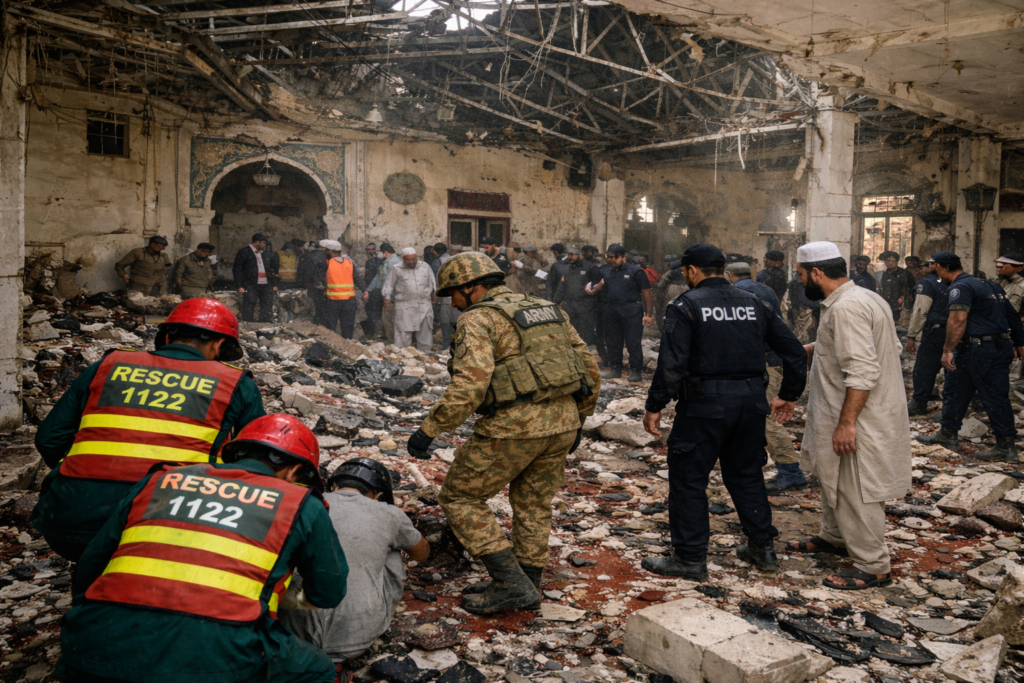
A suicide bombing at a Shia mosque on the outskirts of Islamabad, Pakistan killed at least 31 people and left dozens wounded on Friday.
According to Al Jazeera, the explosion took place during Friday prayers at the Imam Bargah Qasr-e-Khadijatul Kubra mosque in the Tarlai area. The blast caused widespread devastation inside the mosque, sending worshippers into panic as rescue teams rushed to the scene.
Pakistan’s Defence Minister Khawaja Asif said the mosque’s security guards attempted to stop the attacker. He added that the suspect opened fire at the guards before detonating explosives among worshippers.
In a statement, the Islamabad administration said 169 people were taken to hospitals after emergency services reached the site, Al Jazeera reported.
Later on Friday evening, ISIL (Islamic State) claimed responsibility for the attack through its Telegram channel, according to Reuters. The group released an image it said showed the attacker holding a gun, with his face covered and eyes blurred.
Reactions
The bombing was the deadliest attack in Islamabad since the 2008 Marriott Hotel bombing, according to the BBC. Following the explosion, authorities declared an emergency as hospitals struggled to treat the huge number of injured.
Pakistan’s Prime Minister Shehbaz Sharif expressed his “deep grief” over the incident. President Asif Ali Zardari said that “targeting innocent civilians is a crime against humanity”.
“The nation stands with the affected families in this difficult time,” he added.
In a social media post, Zardari claimed it had been “proven” that the attacker had travelled to and from Afghanistan and alleged that “collusion between India and Afghanistan is being revealed”.
Afghanistan’s Taliban government rejected the allegation, the BBC reported, calling Zardari’s remarks “regrettable” and saying Pakistan had “hastily attempted to attribute the incident to Afghanistan without presenting any credible evidence”.
Speaking to the BBC, mosque caretaker Syed Ashfaq, who lives nearby, said he heard gunfire moments before the blast and ran towards the mosque to help.
“By the time I reached it there had already been an explosion,” he said. “Bodies were lying everywhere, some were missing arms, some missing legs. We took the most injured in our own vehicle to hospital.”
The BBC also reported that IS’s Amaq “news agency” released further details, alleging that the attacker entered the mosque compound in Islamabad’s Shahzad area. According to the statement, guards tried to stop him at the outer gate, but he fired at them, injuring two, before entering the mosque and detonating the explosives.
Condemnations and condolences poured in from around the world. The UK’s ambassador to Pakistan, Jane Marriott, described the attack as “abhorrent” in a social media post. The Delegation of the European Union in Pakistan said it “condemns all acts of terrorism” and extended condolences to the victims’ families.
Afghan foreign ministry spokesman Abdul Qahar Balkhi condemned the attack, calling such violence a “contradiction to Islamic and humanitarian values”. Meanwhile, India’s foreign ministry expressed condolences for the loss of life and rejected allegations of involvement as “baseless”, the BBC reported.
The country has witnessed deadly incidents in recent years. While earlier militant attacks were relatively rare in the capital, a similar attack in November last year saw a suicide bomber kill at least 12 people at the entrance of the Islamabad District Judicial Complex. According to Associated Press, a report by the Pakistan Institute for Conflict and Security Studies (PICSS) stated that 2025 was Pakistan’s deadliest year in over a decade, with combat-related deaths increasing by 74 percent. As per the think tank, 3,413 people were killed, up from 1,950 in 2024, with militants accounting for more than half of the deaths.
Cover image is an AI-generated illustration.


Leave a Reply