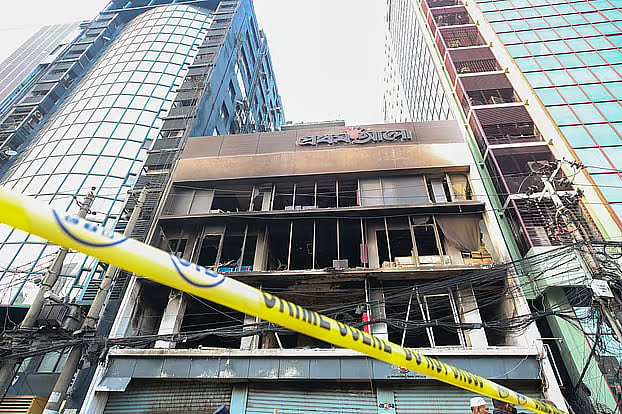
“I was on the evening shift on December 18, 2025,” said Galib Ashraf, a reporter with Prothom Alo, one of Bangladesh’s most influential newspapers. The newsroom was wrapping up work and preparing to leave around 11:00 p.m., when a colleague alerted staff that online posts showed a mob of more than 100 people moving toward the office.
Within minutes, Ashraf said, about 100 to 150 people had gathered outside the building. Prothom Alo operates from two adjacent office blocks. The mob first assembled outside the building where Ashraf was working, prompting staff to rush downstairs and shut all entry and exit points.
Soon after, the crowd shifted to the second building, which was then set on fire. Ashraf, who was in the other block, watched the situation unfold from the 13th floor as flames engulfed the neighboring office.
Staff remained trapped inside for nearly an hour and a half. Around 12:35 a.m., Ashraf said, everyone in his building was escorted to the ground floor. The shutter was opened briefly, and staff rushed out, blending into the people on the street to avoid being identified by the mob. Ashraf later told Newting that police arrived only after the building had already been torched.
Sajjad Sharif, managing editor of Prothom Alo, described the attackers as drawn largely from far-right groups opposed to democratic processes and elections. From his perspective, the assault served multiple purposes: symbolic, to intimidate and dismantle the institution; and ideological, targeting newspapers that advocate for democracy, secularism, and Bangladesh’s historic 1971 legacy. “They see us not just as news organizations, but as an ideology they oppose,” Sharif said.
The attacks on Prothom Alo and The Daily Star marked a dramatic shift in Bangladesh’s media landscape. Journalists are no longer contending only with predictable state pressure but also face unpredictable, ideologically motivated mobs. Newsrooms are recalibrating risk, physical safety, and editorial judgment, as extremist forces and right-wing groups increasingly shape the environment in which reporters operate.
The Shift From Predictable State Pressure to Mobs
During Sheikh Hasina’s rule, journalists faced intense but relatively predictable pressure. “You knew the red lines,” said Nazmul Ahsan, executive editor of Netra News. Criticizing the prime minister or investigating her family could lead to harassment, intimidation, surveillance, or prison. Pressure was often indirect: media owners were targeted through intelligence agencies, and the withdrawal of government advertising, a major revenue source, was routinely used to discipline newsrooms.
“The government was bad, no one would question that,” Ahsan said. “But it was a rational actor. You knew what would happen if you crossed the line.”
Since Hasina’s fall in 2024, the nature of the threat has changed. “Now the danger doesn’t come from the state alone,” Ahsan said. “It comes from mobs, organized or unorganized, who decide your reporting is biased or unfair.” The problem, he explained, is unpredictability: “You don’t know who they are, where the red line is, or what they might do. They might burn down an entire building, like they did in December.”
Personal Safety: A New Frontline
In the days following the attacks, the first change for many journalists was not editorial; it was physical.
“Today, we don’t even use our press cards in public,” said Tanjila Tasnim, a reporter with The Daily Star. “If people find out we are journalists, especially from The Daily Star there is a fear they might attack us.”
Tasnim said editors and senior colleagues advised reporters to move cautiously in public spaces. “We are told to be very sensitive about where we go, who we speak to, and how we introduce ourselves. Sometimes, we are told not to say we are journalists or from The Daily Star at all.”
Galib Ashraf described a similar shift. Four days after the attack, he attended Dhaka University and joined a group of former students in discussion. As usual, he introduced himself as a journalist from Prothom Alo. One of the men suddenly shouted, “You people are anti-democracy, anti-Bangladesh.” Since then, Ashraf says he thinks twice before revealing his profession.
Credibility Under Scrutiny
The December attacks prompted a reassessment of verification and editorial rigor.
“Since the attack at The Daily Star, one clear change in my reporting is that I now verify every fact, quote, and allegation with greater rigor than before, particularly in stories involving powerful individuals, institutions, or religious sensitivities,” said Asaduz Zaman, a reporter at The Daily Star.
Another journalist, Zia Choudhury from Business Standard, told Newting that many newsrooms are now cautious about publishing reports related to politics, religion, or minority communities. “There is a sense of self-censorship even among reporters about whether we should report on sensitive topics or wait and observe the situation.”
A local journalist, speaking on condition of anonymity, said that this reflects a deficit of trust in legacy media. Many people believe newspapers failed to report human rights violations during the Hasina era. “Now the masses are becoming more widely right-wing Islamist,” the journalist said, giving the example of a recent op-ed by a psychologist warning parents about signs of extremism in children, which provoked public outrage. “People call major media here liberals, not Islamic.”
The Changing Power Landscape
For veteran journalist M. Abul Kalam Azad, the attacks revealed a fragmented power landscape after Hasina’s ouster.
“During Sheikh Hasina’s time, we knew who the enemies of the media were,” he told Newting. “After her fall, we thought those pressures would disappear. We were wrong.”
Azad noted that multiple actors now exert influence over the media: student leaders who led the 2024 movement, newly formed political parties, older parties like the BNP, Jamaat-e-Islami, and increasingly right-wing Islamist forces. “They all emerged as stakeholders almost overnight,” he said, placing intense pressure on newsrooms and making the independent media ecosystem more fragile.
“The most surprising thing was the silence of the state,” Azad said. “We knew mobs were being mobilized that night. There were announcements that people would gather in front of the newspaper offices. We expected protests, maybe stone-throwing, not arson. The interim government and security forces were watching as the vandalism unfolded.”
Historical Context and Media Frustrations
Azad added that hostility toward legacy media outlets such as Prothom Alo is partly rooted in the newspapers’ historical reporting. “During Hasina’s regime, all the media helped establish the narrative that it was the government’s role to counter terrorism and extremism no one else could. Even though many raids and arrests were false or staged, the media did not cover those stories. They only reported what police and security forces said. That angered extremist forces,” he explained.
Sharif echoed this view, highlighting that the mobs perceived newspapers not just as institutions, but as ideological threats. “Some were symbolic burning our office to hit and intimidate us,” he said. “Others targeted us because we continue to advocate for democracy, elections, secularism, and the 1971 legacy. They see our institutions as opposing their ideology.”
The New Reality of Journalism
For many journalists, the attacks are a turning point in how they navigate reporting. Physical safety, editorial rigor, and self-censorship have all become priorities.
“Now, the red lines are invisible,” Ahsan said. “You can’t predict where danger will come from. You can’t prepare as you did under Hasina. The threat is in the streets as much as in the state apparatus.”
Tasnim summarized the new reality: “There is still a risk. People could come again. We must do our work, but we must be careful, more careful than ever.”
The December attacks marked the end of an era in which journalists in Bangladesh could calculate the risks of state repression. Today, reporters face unpredictable mobs, ideological hostility, and the remnants of extremist networks released after Hasina’s fall. Newsrooms are responding with a combination of physical caution, stricter verification, and editorial self-restraint, but the question lingers: in a landscape where journalism itself is a target, how can reporters continue to uphold the public’s right to know?

Leave a Reply