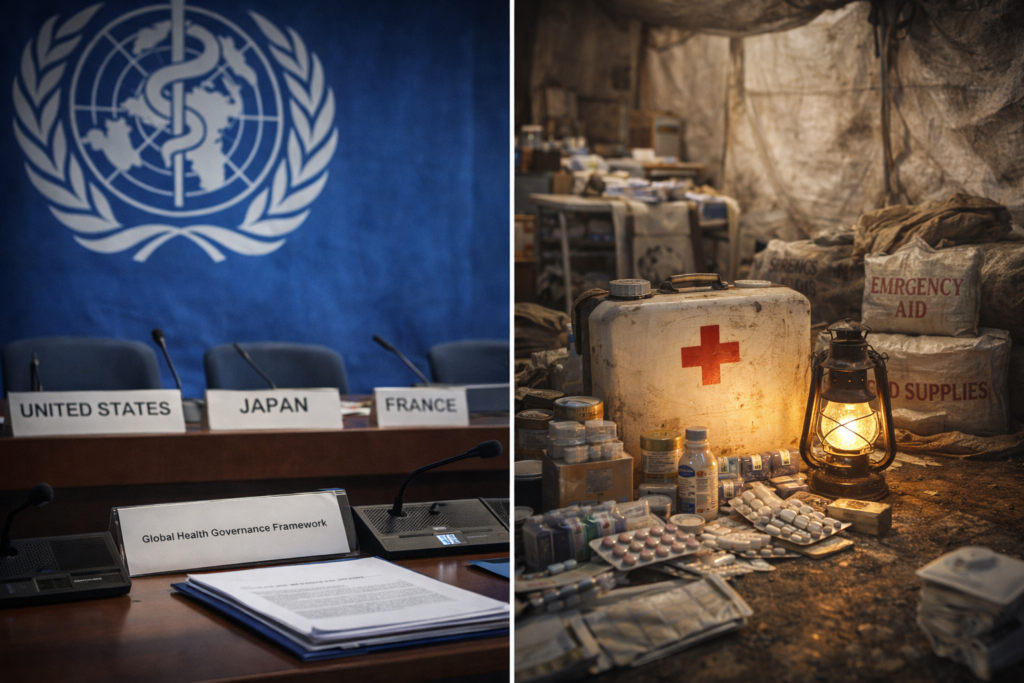
At the World Health Organization’s Executive Board meeting in February, member states gathered to debate the future architecture of global healthcare. The agenda moved well beyond immediate crises. Delegates discussed how organ transplantation should be regulated, how universal health coverage ought to be measured and financed, and how digital systems would underpin public health governance in the years to come.
These are not temporary decisions. They shape how health systems will function long after emergencies fade from view.
Yet not all countries were equally positioned to shape them.
Two Tracks of Global Health Governance
Across the EB158 agenda, a structural divide runs quietly through the documents. Some countries appear as participants in system-building, proposing standards, shaping metrics and debating governance models. Others appear almost entirely as emergency settings, places where systems have collapsed, populations are displaced and external response is required.
In theory, countries move between these categories. In practice, some rarely do.
For these countries, emergency framing has become routine rather than exceptional. They recur in reports on outbreaks, humanitarian access and fragile health infrastructure, but are largely absent from discussions about long-term reform. Their health challenges are documented in detail, while their role in shaping future frameworks remains marginal.
This distinction matters because emergency health is governed differently from long-term health systems. Emergency mechanisms prioritize speed, control and external coordination. They rely on short-term funding cycles and decision-making structures that sit largely outside national institutions. They are designed to stabilize situations, not to hand authority back.
As WHO increasingly formalises global health governance, setting standards for data use, transplantation ethics and coverage metrics, the cost of remaining outside these conversations grows. Countries that do not help shape these frameworks are still expected to implement them.
They are governed by rules they did not meaningfully help write.
When Emergency Becomes the Default
The Executive Board is where technical norms become binding policy. Countries with stable governance and administrative capacity tend to appear not only in reports but in statements, amendments and negotiations. Their preferences are recorded. Their objections are debated.
For countries locked into emergency engagement, participation is far more limited. Their situations are summarized by the secretariat or partner organizations. Their needs are assessed. Their data is presented. What is often missing is their voice in deciding how recovery should look, or when emergency governance should give way to sovereignty.
This is not framed as exclusion within the documents. It is treated as a functional necessity.
WHO’s political neutrality plays a central role in this arrangement. By avoiding explicit references to occupation, sanctions or contested sovereignty, the organization preserves its ability to operate across conflict lines. Health outcomes are separated from political responsibility, even when political conditions directly shape health capacity.
That neutrality enables access. It also obscures permanence.
When emergency framing persists year after year, it begins to function less as a response and more as a category. Health systems are managed rather than rebuilt. Authority remains external. The transition out of crisis is assumed rather than planned.
The EB158 documents do not address how countries exit this loop. There is no agenda item on prolonged emergency governance, no discussion of how participation gaps affect system recovery, no mechanism to ensure that countries described primarily as crises can influence the standards they are judged against.
As a result, a quiet asymmetry takes shape. Some states help design the future of global health. Others are treated as places where that future will eventually be applied.
No WHO document states this explicitly. The imbalance emerges through structure, repetition and silence.
At a meeting where equity was repeatedly invoked as a guiding principle, the question of who gets to help define global health’s future remained largely unexamined. Not equity of outcomes alone, but equity of authority.
Until that question is addressed, global health will continue to operate on two tracks. One builds systems. The other manages emergencies, often indefinitely.


Leave a Reply