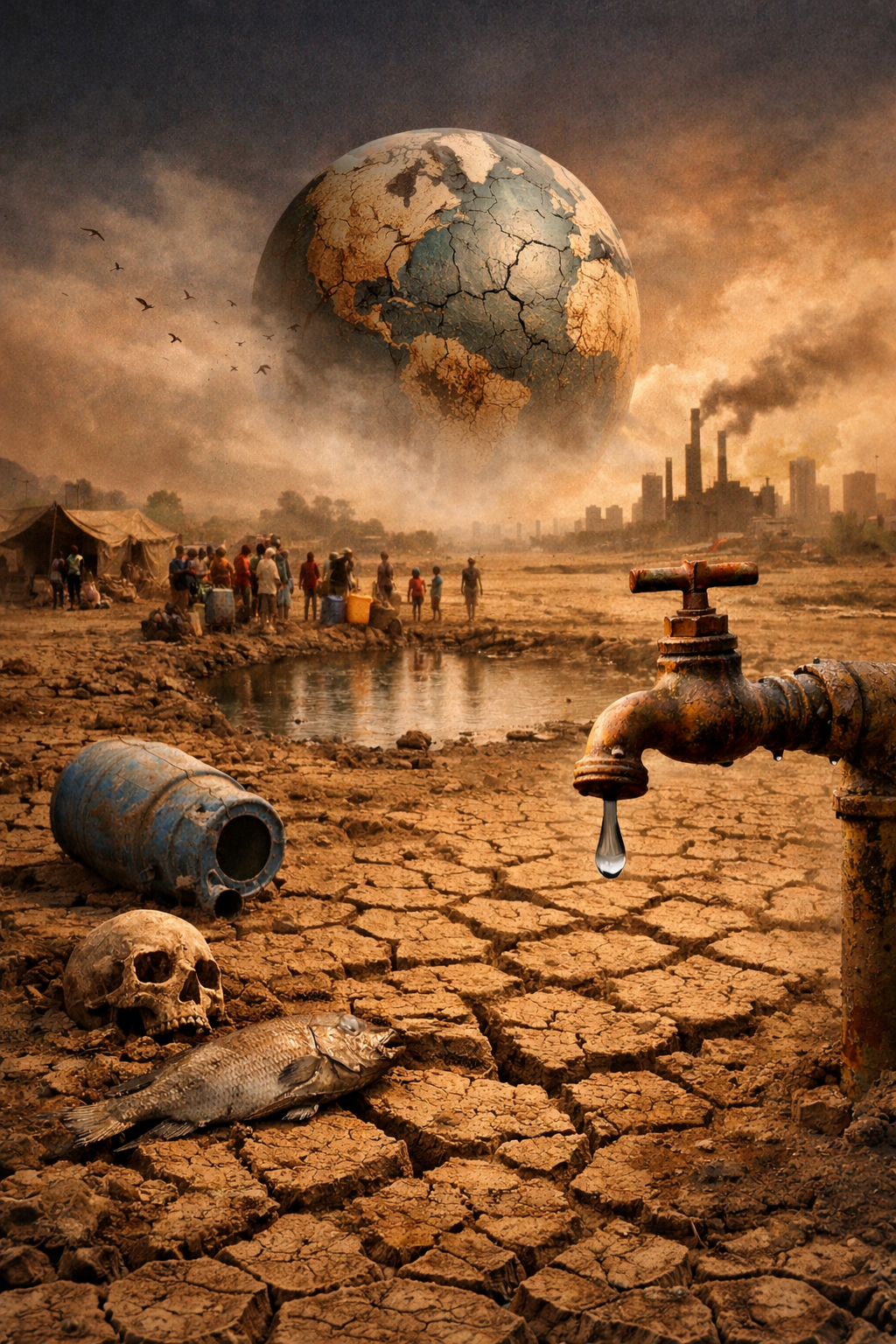
The world has entered an era of “global water bankruptcy,” with consequences that may no longer be reversible, according to a new report by the United Nations University.
Nearly three-quarters of the global population now live in countries classified as water-insecure or critically water-insecure. About 2.2 billion people still do not have access to safely managed drinking water, while 3.5 billion lack safe sanitation. Nearly 4 billion people experience severe water shortages for at least one month every year.
Released last week, the report also highlights accelerating environmental losses. More than 30% of the world’s glacier mass has disappeared since 1970, worsening water shortages across regions that depend on snow and ice melt.
Global Water Systems Shrink
Regions across the globe are already facing visible and growing water stress, the report says. Kabul could become the first modern city to completely run out of water. Mexico City is sinking by nearly 20 inches a year due to excessive groundwater extraction. In the U.S. Southwest, states remain locked in disputes over the shrinking waters of the drought-hit Colorado River.
“These impacts translate directly into human consequences,” the report notes.
According to the United Nations University Institute for Water, Environment and Health (UNU-INWEH), traditional terms such as “water crisis” or “water stress” no longer reflect the scale of the problem.
“If you keep calling this situation a crisis, you’re implying that it’s temporary. It’s a shock. We can mitigate it,” said Kaveh Madani, director of UNU-INWEH and the report’s author.
“With bankruptcy, while it’s still vital to fix and mitigate where possible, ‘you also need to adapt to a new reality – to new conditions that are more restrictive than before,’” he told CNN.
Understanding Water Bankruptcy:
The idea of water bankruptcy, the report explains, is similar to financial debt. Nature provides water through rain and snow, but humanity is using more than it receives. Rivers, lakes, wetlands, and underground aquifers are being drained faster than they can recover, while climate change-driven heat and drought are reducing supplies even further.
As a result, rivers and lakes are shrinking, wetlands are drying up, aquifers are collapsing, land is sinking, and desertification is spreading. Snowpacks are thinning and glaciers continue to melt.
The report’s figures underline the scale of the damage. More than half of the world’s large lakes have lost water since 1990. Around 70% of major aquifers are in long-term decline. Wetlands covering an area nearly the size of the European Union have vanished over the past 50 years, and glaciers have shrunk by about 30% since 1970. Water pollution has further reduced the amount available for safe drinking, even in less-stressed regions.
In the Middle East and North Africa, extreme water stress intersects with climate vulnerability, low agricultural productivity, heavy reliance on energy-intensive desalination, and frequent sand and dust storms. In parts of South Asia, groundwater-dependent farming and rapid urban growth have led to falling water tables, land subsidence, and mounting pressure on cities. In the American Southwest, the Colorado River has become a symbol of water resources that were over-allocated and overused.
“Millions of farmers are trying to grow more food from shrinking, polluted, or disappearing water sources. Without rapid transitions toward water-smart agriculture, water bankruptcy will spread rapidly,” Madani said.
He added that, as with climate change or pandemics, global water bankruptcy does not affect every region equally but has reached a scale where enough systems have crossed irreversible thresholds to become a planetary condition.
The report urges major changes, including transforming agriculture through crop shifts and efficient irrigation, improving water monitoring using AI and remote sensing, cutting pollution, and strengthening protection for wetlands and groundwater.
“Water bankruptcy is becoming a driver of fragility, displacement, and conflict,” said UN Under-Secretary-General Tshilidzi Marwala, Rector of UNU. “Managing it fairly – ensuring that vulnerable communities are protected and that unavoidable losses are shared equitably – is now central to maintaining peace, stability, and social cohesion,” he added.



Leave a Reply